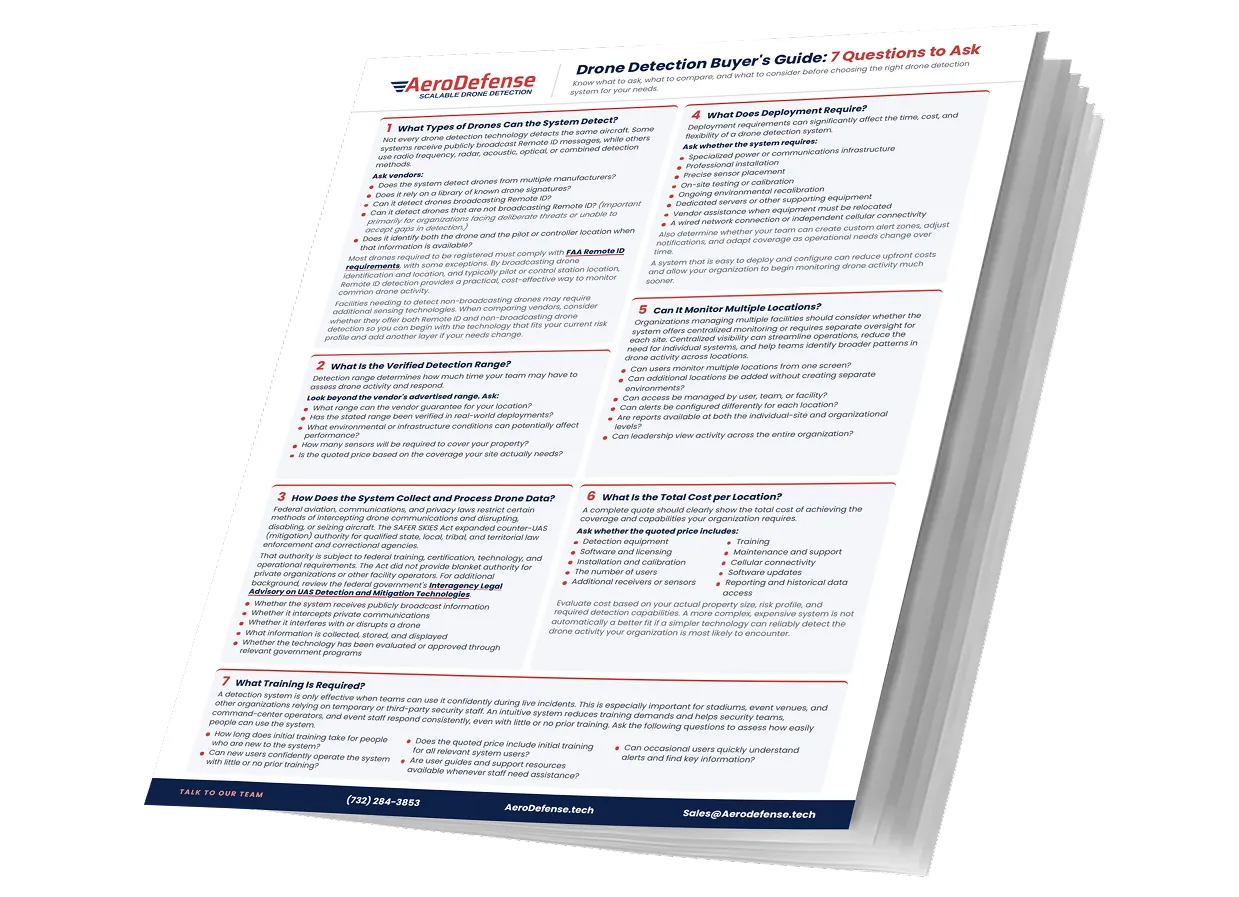
Drone Detection Buyer’s Guide: 7 Questions to Ask

Know what to ask, what to compare, and what to consider before choosing the right drone detection system for your needs.
BEFORE YOU CHOOSE

7 Questions Before Choosing a Drone Detection System

Drone detection systems differ significantly in what and how they detect, how they are deployed, and what they ultimately cost. Use these seven questions to look beyond vendor claims, compare technologies, identify limitations, and find the solution that best fits your facilities, operations, security priorities, and budget.
QUESTION 1

What Types of Drones Can the System Detect?

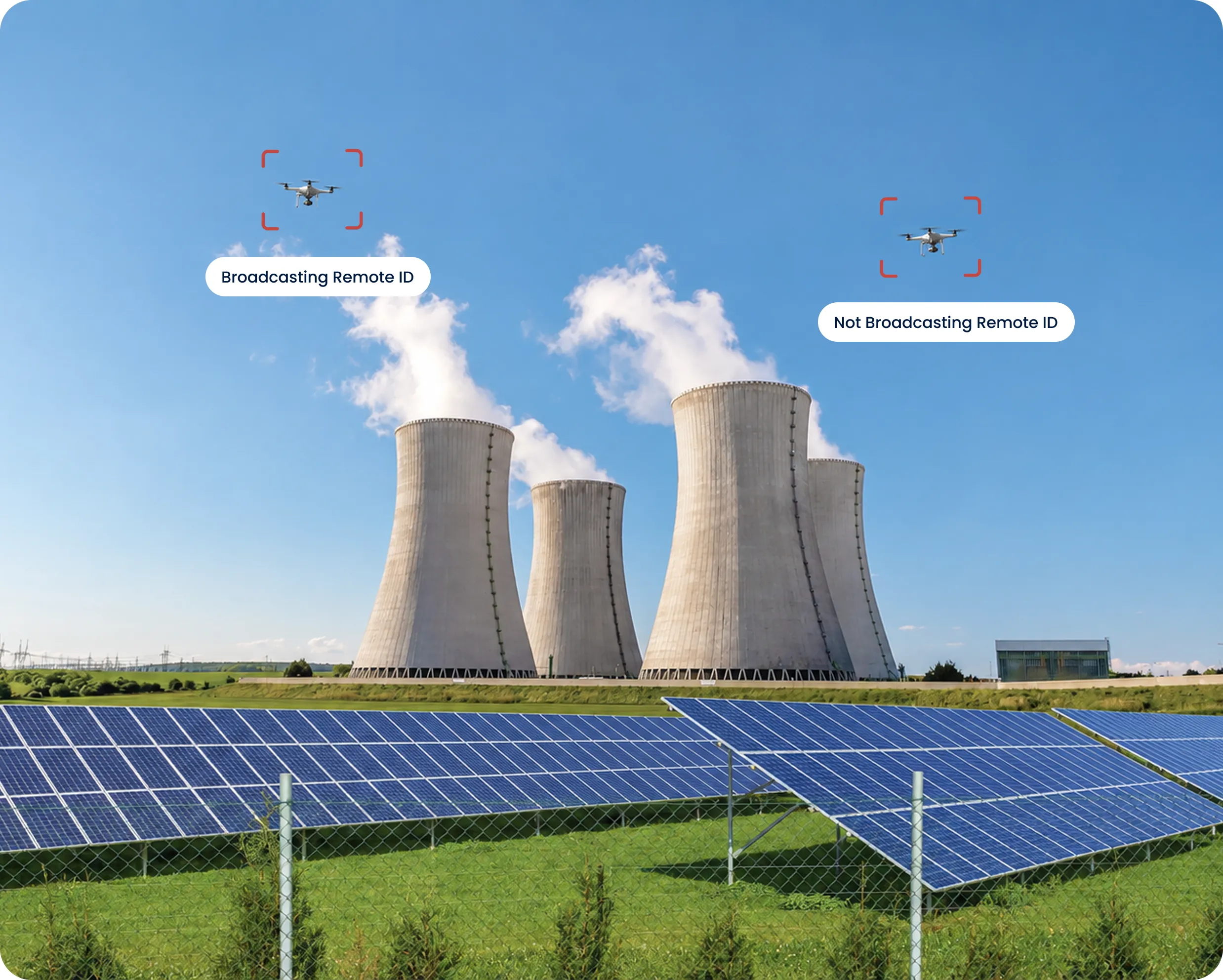
Not every drone detection technology detects the same aircraft. Some systems receive publicly broadcast Remote ID messages, while others use radio frequency, radar, acoustic, optical, or combined detection methods.
Ask vendors:
Does the system detect drones from multiple manufacturers?
Does it rely on a library of known drone signatures?
Can it detect drones broadcasting Remote ID?
Can it detect drones that are not broadcasting Remote ID? (Important primarily for organizations facing deliberate threats or unable to accept gaps in detection.) 
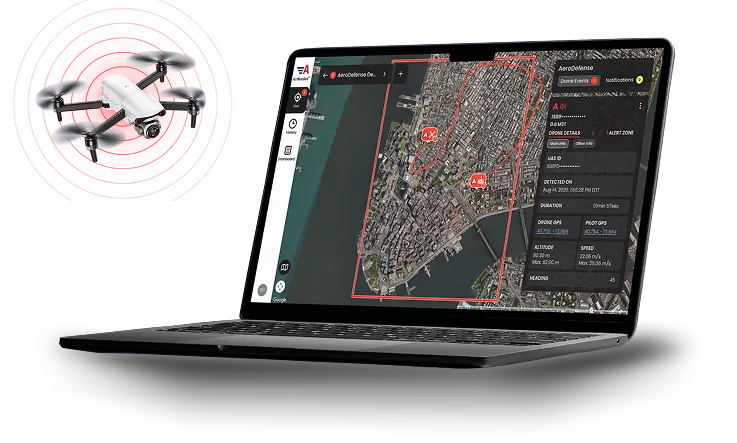
Does it identify both the drone and the pilot or controller location when that information is available?
Most drones required to be registered must comply with FAA Remote ID requirements, with some exceptions. By broadcasting drone identification and location, and typically pilot or control station location, Remote ID detection  provides a practical, cost-effective way to monitor common drone activity.
Facilities needing to detect non-broadcasting drones may require additional sensing technologies. When comparing vendors, consider whether they offer both Remote ID and non-broadcasting drone detection so you can begin with the technology that fits your current risk profile and add another layer if your needs change.
QUESTION 2

What Is the Verified Detection Range?

Detection range determines how much time your team may have to assess drone activity and respond.
Look beyond the vendor’s advertised range. Ask:
What range can the vendor guarantee for your location?
Has the stated range been verified in real-world deployments?
What environmental or infrastructure conditions can potentially affect performance?
How many sensors will be required to cover your property?
Is the quoted price based on the coverage your site actually needs?
QUESTION 3

How Does the System Collect and Process Drone Data?

Federal aviation, communications, and privacy laws restrict certain methods of intercepting drone communications and disrupting, disabling, or seizing aircraft. The SAFER SKIES Act expanded counter-UAS authority under 6 U.S.C. §124n for qualifying state, local, tribal, and territorial law enforcement and correctional agencies, including certain detection methods that would otherwise be restricted by federal law.
That authority is subject to federal training, certification, technology, and operational requirements. The Act did not provide blanket authority for private organizations or other facility operators. For additional background, review the federal government's Interagency Legal Advisory on UAS Detection and Mitigation Technologies.
Whether the system receives publicly broadcast information
Whether it intercepts private communications
Whether it interferes with or disrupts a drone
Whether the technology has been evaluated or approved through relevant government programs
What information is collected, stored, and displayed
Red flag
If a system can identify the serial number of a drone that is not broadcasting Remote ID, ask how. It may involve intercepting communications that require specific legal authority. Require the vendor to explain the collection method and legal basis for your organization’s use.

QUESTION 4

 What Does Deployment Require?

Deployment requirements can significantly affect the time, cost, and flexibility of a drone detection system. Ask whether the system requires:
Specialized power or communications infrastructure
Professional installation
Precise sensor placement
On-site testing or calibration
Ongoing environmental recalibration
Dedicated servers or other supporting equipment
Vendor assistance when equipment must be relocated
A wired network connection or independent cellular connectivity
Also determine whether your team can create custom alert zones, adjust notifications, and adapt coverage as operational needs change over time.
A system that is easy to deploy and configure can reduce upfront costs and allow your organization to begin monitoring drone activity much sooner.
QUESTION 5

Can It Monitor Multiple Locations?

Organizations managing multiple facilities should consider whether the system offers centralized monitoring or requires separate oversight for each site. Centralized visibility can streamline operations, reduce the need for individual systems, and help teams identify broader patterns in drone activity across locations.
01
Can users monitor multiple locations from one screen?
02
Can additional locations be added without creating separate environments?
03
Can access be managed by user, team, or facility?
04
Can alerts be configured differently for each location?
05
Are reports available at both the individual-site and organizational levels?
06
Can leadership view activity across the entire organization?
QUESTION 6

What Is the Total Cost per Location?

A complete quote should clearly show the total cost of achieving the coverage and capabilities your organization requires. Ask whether the quoted price includes:
Detection equipment
Software and licensing
Installation and calibration
The number of users
Additional receivers or sensors
Training
Maintenance and support
Cellular connectivity
Software updates
Reporting and historical data access
Evaluate cost based on property size, risk profile, and required detection capabilities. A more expensive system is not automatically a better fit.
A simpler technology may be a better fit if it reliably detects the drone activity your organization is most likely to encounter.
QUESTION 7

What Training Is Required?

A detection system is only effective when teams can use it confidently during live incidents. This is especially important for stadiums, event venues, and other organizations relying on temporary or third-party security staff.
An intuitive system reduces training demands and helps security teams, command-center operators, and event staff respond consistently, even with little or no prior training. Ask the following questions to assess how easily people can use the system.
How long does initial training take for people who are new to the system?
Can new users confidently operate the system with little or no prior training?
Does the quoted price include initial training for all relevant system users?
Can occasional users quickly understand alerts and find key information?
Are user guides and support resources available whenever staff need assistance?

Find the Right Drone Detection Solution

AeroDefense offers drone detection solutions for organizations that need real-time awareness, pilot location information, historical intelligence, and visibility across one or multiple sites.
Our team can help you evaluate your facility, likely drone activity, required coverage, and operational needs.
BUYER’S GUIDE

Get the Drone Detection Buyer’s Guide

Enter your email below, and we’ll send the Drone Detection Buyer's Guide directly to your inbox.
Thank you! Your submission has been received!
Oops! Something went wrong while submitting the form.