Understand the legal landscape surrounding drone detection and explore AirWarden’s approach to airspace security.
Drone Detection Without Accessing Private
Communications or Interfering With Flight
AeroDefense develops drone detection solutions that provide real-time awareness and historical intelligence without jamming drones, taking control of them, or interfering with their operation.
AirWarden Essentials software works with AirWarden Remote ID Receivers for public Remote ID broadcasts and AirWarden Spectrum sensors, which combine Remote ID receiving with proprietary, patented radio frequency (RF) spectrum sensing to detect non-broadcasting drones without intercepting signal content or creating wiretap exposure from RF packet inspection.
Commercial organizations, critical infrastructure, correctional facilities, universities, stadiums, and government agencies rely on AirWarden to establish real-time airspace awareness across complex environments.
Federal laws affecting drone detection and mitigation can apply differently depending on what a technology does and how it is operated. Legal requirements may differ depending on:
The types of signals collected by the drone detection system
Whether it intercepts packet content
Whether it transmits radio-frequency energy
Whether it disrupts or takes control of an aircraft
Who operates the technology
Where the system is deployed and how it is operated
SAFER SKIES Act: Authority and Data Restrictions
TheSAFER SKIES Act expanded authority under 6 U.S.C. §124n for qualifying law enforcement and correctional agencies to use certain drone detection methods that would otherwise be legally restricted, subject to strict requirements.
If a system provides a serial number or recognizes repeat visits from a drone not broadcasting Remote ID, ask how that information is obtained and what legal authority permits its collection and use. The implementing regulations prohibit agencies from purchasing or relying on unlawfully intercepted drone control communications and restrict how communications acquired under this authority may be retained and shared.
How AirWarden Detects Drone Activity
Remote ID Detection
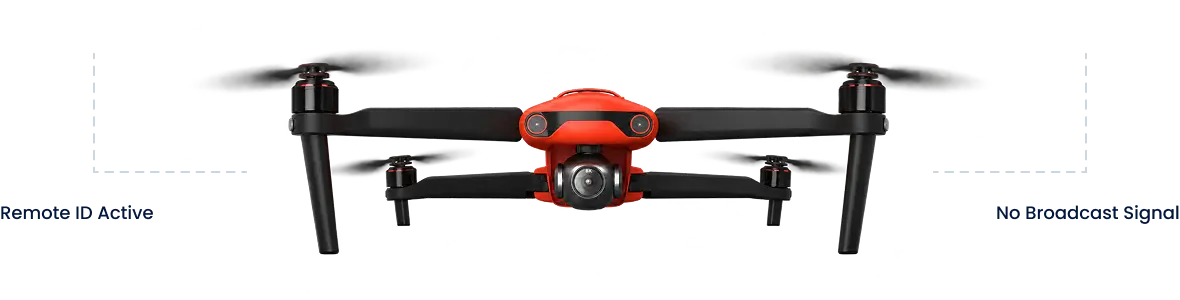
The FAA requires most drones operating in the United States to broadcast Remote ID information. These signals are intentionally broadcast for anyone within range to receive and include identification and location information about the drone.
AirWarden Remote ID receives and processes these publicly broadcast Remote ID messages. It does not access the FAA’s private drone-registration database or reveal the registered owner’s identity. If owner identification is needed, organizations can provide the detected Remote ID information to law enforcement, which may request the associated registration information from the FAA.
AirWarden Spectrum identifies the presence, characteristics, and direction of radio-frequency activity associated with drone operations.
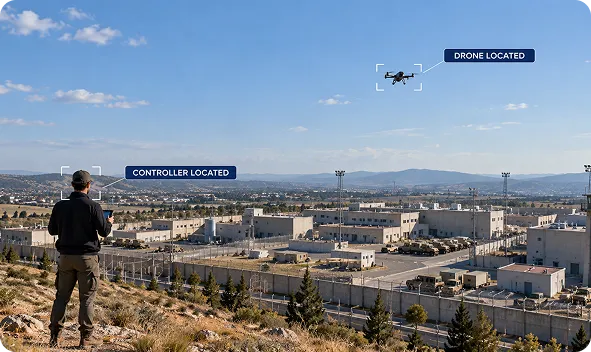
The system receives publicly broadcast Remote ID messages and uses patented, passive RF sensing to detect drones that may not broadcast Remote ID. It operates without intercepting packet content, accessing private communications between a drone and its controller, transmitting signals, or interfering with drone operations. This approach avoids wiretap exposure while allowing organizations to add vital detection layers at their most vulnerable sites.
The FAA’s Remote ID rule generally requires registered drones and drones required to be registered to broadcast identification and location information, subject to applicable exceptions and authorizations.
AirWarden receives Remote ID messages broadcast under Part 89. It does not access private FAA registration records or independently determine the identity of a drone’s registered owner.
Protection of Certain Facilities and Assets From Unmanned Aircraft
Section 124n authorizes specified federal agencies, as well as state, local, Tribal, and territorial law enforcement and correctional agencies under the SAFER SKIES Act framework, to take certain drone detection and mitigation actions otherwise restricted by federal laws governing communications interception, aircraft interference, unauthorized computer access, and satellite interference. This authority applies only when statutory and regulatory requirements are met and does not constitute a general waiver available to private organizations.
AirWarden is built for passive detection rather than active mitigation. The system monitors public Remote ID broadcasts and RF energy patterns without accessing private communications, transmitting interfering signals, or altering aircraft flight.
The Wiretap Act generally prohibits the intentional interception of certain wire, oral, or electronic communications unless an exception or legal authorization applies.
AirWarden is designed not to intercept the contents of nonpublic drone communications. Both AirWarden Remote ID and AirWarden Spectrum receive and process publicly broadcast Remote ID messages.
AirWarden Spectrum also layers passive RF sensing to detect non-broadcasting drones without performing RF packet inspection or accessing any nonpublic communications between a drone and its controller.
This statute regulates the installation and use of devices or processes that capture certain dialing, routing, addressing, or signaling information associated with electronic communications.
AirWarden operates without intercepting packet content or recording private drone communications.
Its Remote ID capabilities process information intentionally broadcast under FAA regulations, and its passive RF capabilities analyze signal presence, characteristics, and direction without accessing nonpublic communications content.
Section 2512 restricts the manufacture, distribution, possession, and advertising of devices whose design makes them primarily useful for the surreptitious interception of communications.
AirWarden is designed and marketed for drone detection and airspace awareness—not for surreptitious interception. It operates without intercepting packet content or accessing nonpublic communications.
Section 1367 prohibits specified interference with the authorized operation of communications or weather satellites and obstruction of
satellite transmissions.
AirWarden does not jam, spoof, degrade, or interfere with satellite or navigation signals.
Protection of Certain Government Communications Systems
Section 1362 protects specified communications property and systems used or controlled by the United States, including systems used for military or civil-defense purposes.
AirWarden does not damage, disable, or interfere with existing communications systems.
Federal law prohibits aircraft piracy, including specified acts involving the wrongful seizure or exercise of control over an aircraft through force, violence, threat, or intimidation.
AirWarden does not seize, redirect, or assume control of drones.
BEFORE YOU DEPLOY
Key Considerations When
Evaluating Drone Detection
Organizations considering drone detection should evaluate more than a system’s ability to detect aircraft. They should understand what information it collects and how that information is obtained.
A responsible deployment involves evaluating the technology, understanding applicable legal requirements, and establishing appropriate operational procedures.
A responsible deployment may include:
Monitoring drone activity without disrupting flight
Checking whether the system intercepts nonpublic communications
Coordinating with the FAA on aviation-related deployments
Establishing clear policies for alerts and escalation
Coordinating with law enforcement when necessary
Confirming applicable legal requirements with qualified counsel
FAQ
Legal Drone Detection FAQs ?
Understand the legal requirements, communication restrictions, and permissions for detecting and mitigating unwanted drones.
Didn't find your answer? Chat with the AeroDefense Navigator for immediate assistance.
Does AirWarden interfere with drone communications?
No. AirWarden does not jam, spoof, disrupt, or take control of drone communications or navigation signals.
Does AirWarden perform RF packet inspection?
No. Both AirWarden Remote ID and AirWarden Spectrum receive and process publicly broadcast Remote ID messages. AirWarden Spectrum also analyzes RF activity without intercepting packet content or accessing nonpublic communications between a drone and its controller.
Does AirWarden identify the drone’s owner?
Not by itself. Remote ID broadcasts a serial number or other identification value, but access to the FAA registration information associated with that value is restricted to the FAA and may be made available to authorized law-enforcement or national-security personnel. AirWarden does not access the FAA’s private registration database.
Can a private organization jam or disable a drone over its property?
Generally, private property ownership does not give an organization authority to jam, seize, disable, destroy, or take control of an aircraft. Drone mitigation implicates multiple federal laws and is restricted to specifically authorized entities and circumstances.
Can law enforcement and correctional agencies mitigate drones?
Qualifying state, local, Tribal, and territorial law-enforcement and correctional agencies may exercise specified counter-UAS authority under the SAFER SKIES Act and its implementing regulations. The authority is conditional. Participating agencies and personnel must satisfy the applicable accreditation, training, technology, planning, coordination, privacy, reporting, and operational requirements.
Are all RF-based drone detection systems subject to the same laws?
No. “RF detection” can describe substantially different technical methods. Some systems passively recognize signal activity or direction. Others may access the content of communications, collect nonpublic signaling information, actively transmit RF energy, or manipulate drone protocols. The applicable legal and regulatory requirements depend on what the system actually does—not simply whether it is described as RF-based.
Build Airspace Awareness Without Flight Interference
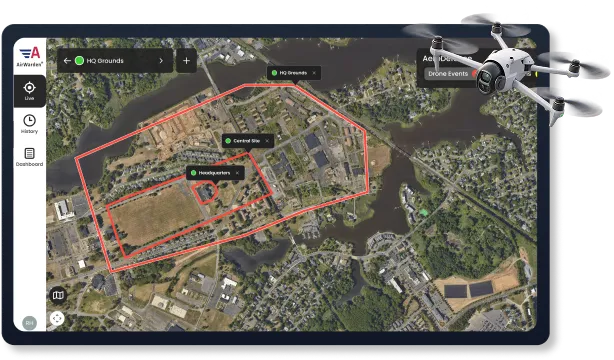
AirWarden provides real-time visibility and historical intelligence to monitor drone activity, document incidents, identify patterns, and coordinate responses.
AeroDefense does not provide legal advice. Laws, regulations, and agency guidance may change, and their application depends on the facts and circumstances of each deployment. Organizations should consult qualified legal counsel before implementing drone detection or mitigation technology.