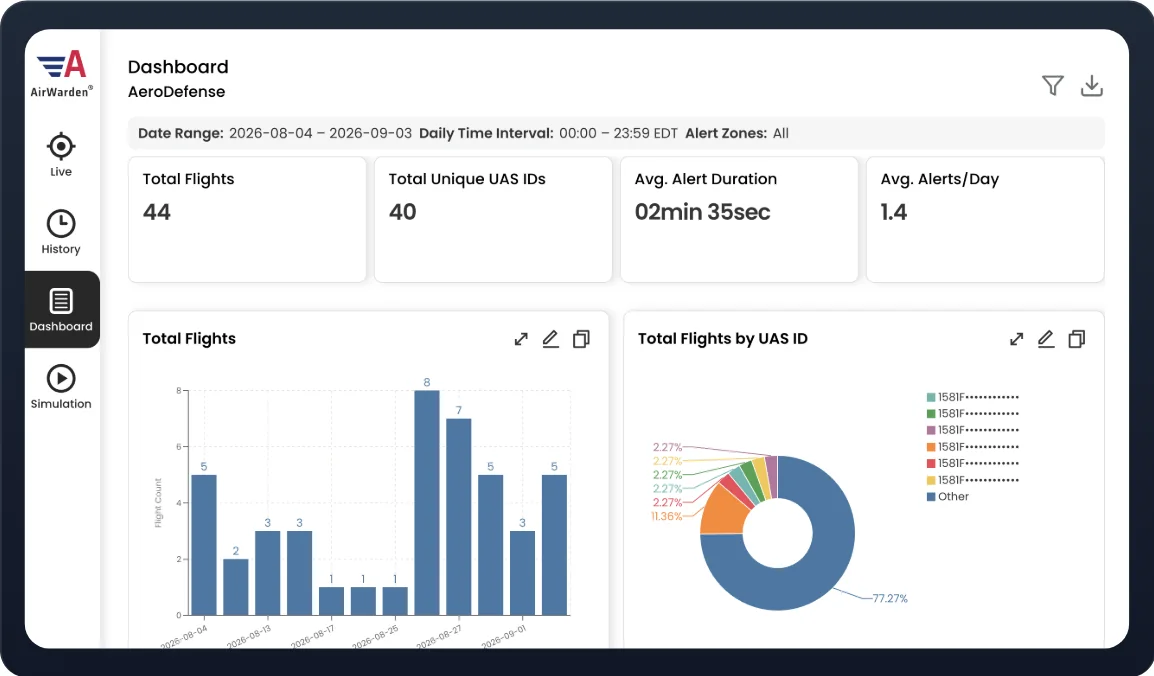
See how AirWarden® delivers real-time airspace awareness to protect military installations.
What Our Customers Say
When deploying to an allied country, we need equipment that operates within their regulatory environment. From our experience, AeroDefense technology met our requirements and was crucial in protecting our troops.
Lieutenant Colonel Jessica Guarini
621st CRS
We thoroughly evaluated the drone detection market, and AeroDefense’s unique ability to find the pilot fills a critical gap in our ability to defend against unauthorized small unmanned aerial systems.
Master Sergeant Kologinsky
87th SFS
THE PROBLEM
Understanding the Risks
to Installation Security
Pre-Operational Surveillance
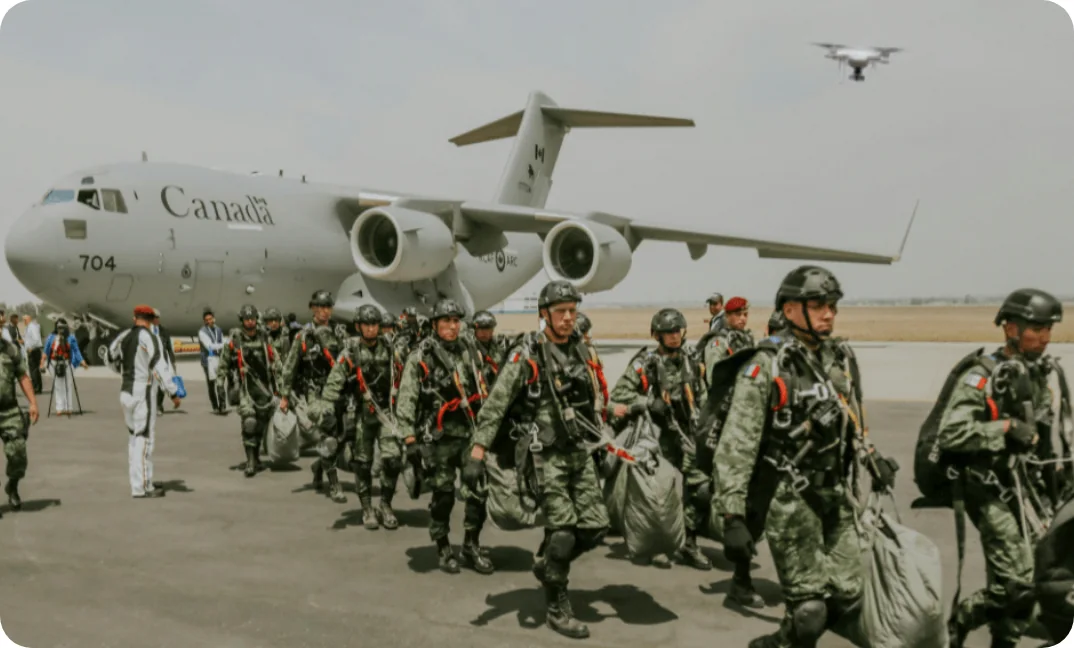
At large-scale installations, persistent drone incursions are used to map flight-line operations, identify security rotations, and establish "patterns of life" for high-value assets.
Intelligence Collection
Drones can act as aerial SIGINT platforms, attempting to capture the electronic or visual signatures of aircraft, vessels, or experimental technology during testing and evaluation.
Operational Security
High-resolution imagery of equipment staging, hangar activity, or troop deployments can be captured and uploaded in real time, compromising mission secrecy before a movement begins.
THE SOLUTION
Intelligence-Led Defense
AirWarden combines real-time detection with historical airspace data to identify threats, uncover patterns, and strengthen installation security.
Proven Deployment
Field-tested and operationally proven at Joint Base McGuire-Dix-Lakehurst (JBMDL), backed by three Small Business Innovation Research (SBIR) contracts including a Tactical Funding Increase (TACFI) Phase II award.
Collaborative Defense
Detects/locates drones and maps flight patterns while utilizing the Collaborative Drone Detection Network (CoDDN)—developed with JBMDL—to share real-time data and historical intelligence with local law enforcement and other agencies.
Streamlined Procurement
Qualifying follow-on purchases derived from AeroDefense’s SBIR work may be awarded directly as SBIR Phase III contracts, simplifying procurement without requiring a new competitive RFP process.
Bring Intelligence-Led
Airspace Defense to
Your Installation
Turn live drone activity and historical data into actionable intelligence for faster, more informed response.
A continuous approach to drone security before, during, and after an incident.
Phase 1
Continuous Monitoring
Before an Incident
24/7/365 Monitoring
The system constantly monitors the environment, requiring zero manual oversight until a verified alert is triggered.
Tiered Alert Zones
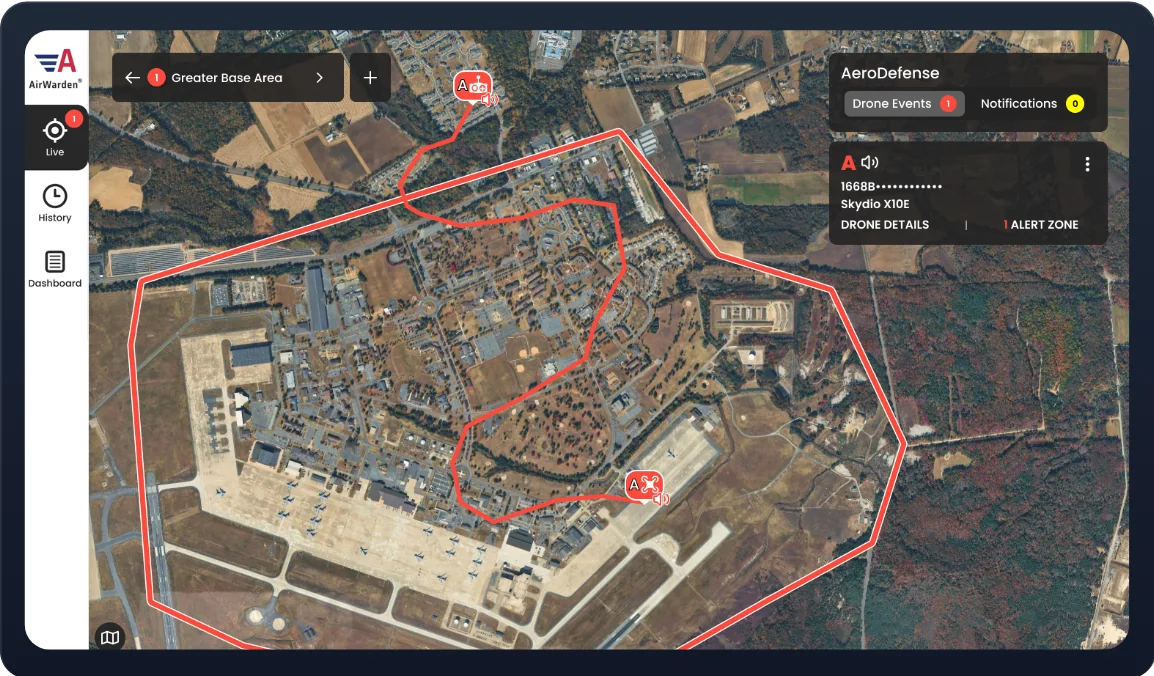
Establish layered response plans by defining digital boundaries around high-consequence assets. Receive instant, high-priority notifications when a drone enters critical areas like flight lines or ammunition depots, while maintaining passive awareness of lower-risk areas.
Trusted Fleet Management
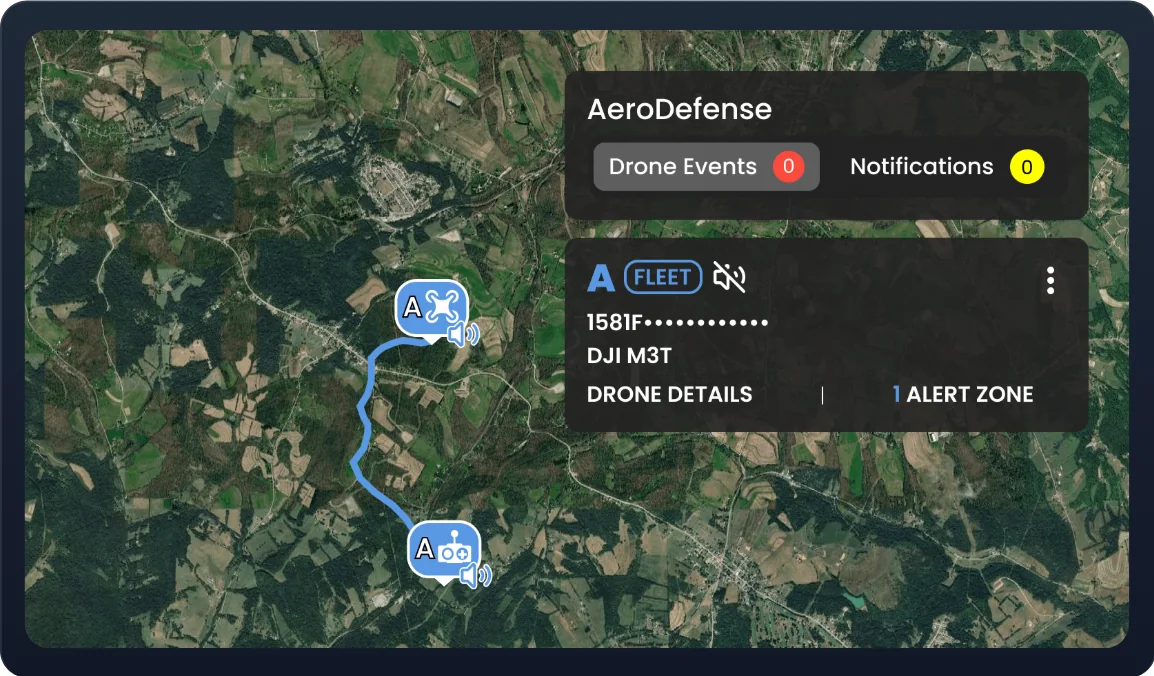
Pre-register base, security, and friendly forces drones to automatically distinguish known assets from unknown ones to focus response teams on potential risks.
Phase 2
Immediate Action
During an Incident
Simultaneous Drone & Pilot Tracking
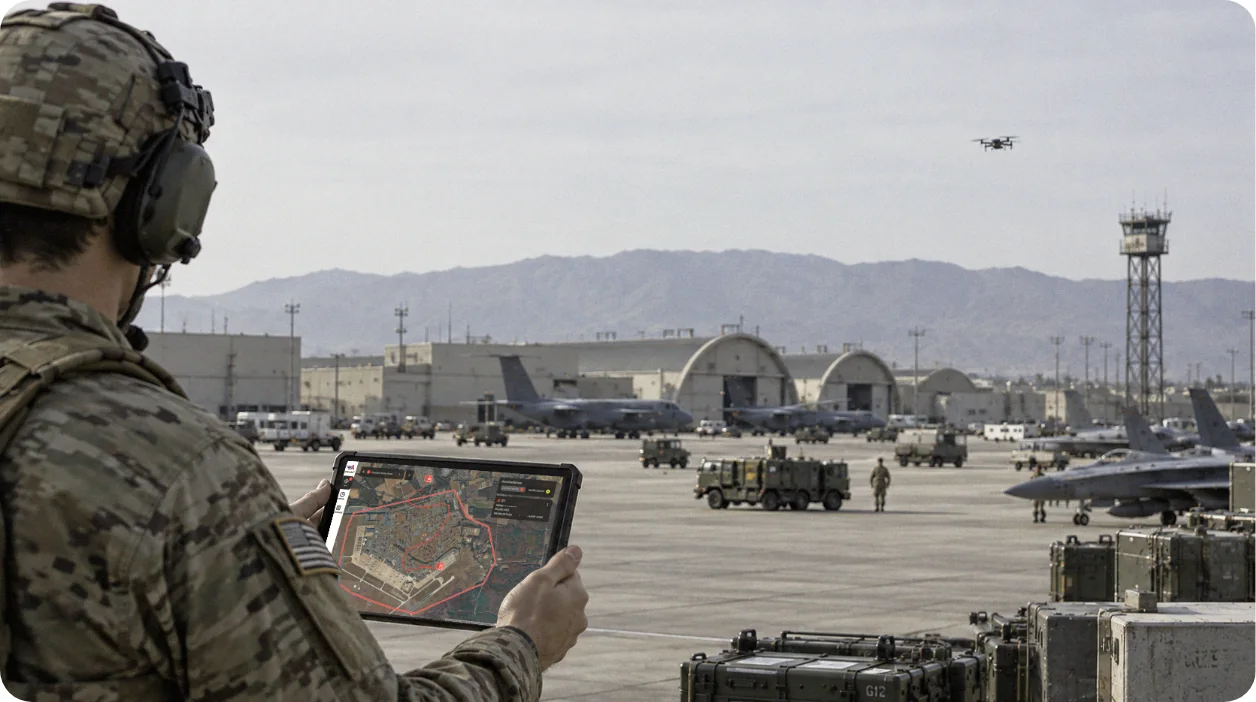
See the real-time location of both the drone and the operator on a single map, enabling a response by base security.
Broad-Spectrum Detection
Detect diverse drone models across major manufacturers to maintain complete airspace visibility.
Cross-Agency Coordination
Share real-time flight data with civilian law enforcement and other authorized partners to support coordinated response beyond the installation perimeter.
Flag Watchlist Threats (AirWarden Remote ID Only)
Add drones to a custom Watchlist during an active flight or directly from historical logs to immediately flag them upon re-entry.
Phase 3
Tactical Analysis
After an Incident
Identify Repeat Offenders
AirWarden identifies unique drone and controller signatures. This allows you to recognize when the same individual returns to the base, shifting the focus from an isolated incident to a persistent security threat.
Pattern-of-Life Detection
Analyze historical flight data to uncover recurring surveillance trends and launch "hot spots" around the installation.
Forensic Data for Documentation
Access historical flight logs and detection data to support incident documentation, federal reporting, and internal security reviews.
UAFR READINESS
Prepare for the Proposed FAA Flight Restrictions (UAFR)
The FAA’s proposed UAFR (Unmanned Aircraft Flight Restriction) framework calls for Remote ID receiving capability and up to 24 months of available drone activity history. Deploying today helps establish the hardware and begin building the historical record to support your future application.
Eligible fixed-site facilities, including certain military installations, may apply for federal drone flight restrictions over or near their property. Applicants must also demonstrate existing ground security.
1
REMOTE ID RECEIVING CAPABILITY
The proposed rule calls for applicants to be capable of receiving Remote ID broadcasts within or in close proximity to the requested UAFR.
2
VERIFIED FLIGHT DATA
The proposed application calls for information on drone activity over the facility during the last 24 months, where available. Start building a historical record now to support a future application.
3
SUPPORT DAY-1 READINESS
The FAA anticipates a significant volume of applications. Having Remote ID receiving capability and available historical flight data in place can help your facility apply as soon as the process opens.
Choose the Right Protection Level for Your Facility
See how AirWarden Remote ID and AirWarden Spectrum compare. Both solutions include AirWarden Essentials software for live monitoring, configurable alerts, fleet management, watchlists, and historical reporting.
AirWarden Remote ID
Most Popular
AirWarden Spectrum (RF Sensing)
Best For
Military installations needing scalable, cost-effective drone monitoring across large or geographically dispersed areas.
High-security military installations requiring permanent detection of non-broadcasting drones and advanced RF monitoring.
How It Works
Uses compact Remote ID receivers to ingest and process real-time telemetry from compliant drones and pilots.
Passively monitors local radio frequencies to detect proprietary drone signals from non-broadcasting aircraft.
Hardware & Setup
Low-profile, self-installable receivers. Your staff can mount and connect them with zero field technicians or calibration required.
Professionally installed RF sensors with technician deployment and environmental calibration to account for complex RF environments.
Primary Advantage
Rapidly scale detection coverage while gaining real-time and historical intelligence on drone activity and pilot locations when available.
Detects more sophisticated or non-compliant drone activity that may bypass Remote ID-based detection.
Take Command of Your Airspace With Proven Drone Detection
Request a technical briefing to see how AirWarden can integrate into your Force Protection mission and operational requirements. Discover why we are the trusted vendor for persistent airspace oversight at JBMDL.
Thank you! Your submission has been received!
Oops! Something went wrong while submitting the form.
FAQ
Military Airspace Security FAQs ?
Get clear answers to common questions about drone threats, detection capabilities, UAFR eligibility, procurement options, and recurring surveillance around military installations.
Didn't find your answer? Chat with the AeroDefense Navigator for immediate assistance.
Will military installations be eligible for an Unmanned Aircraft Flight Restriction (UAFR)?
Yes. Under the FAA’s proposed UAFR rule, eligible fixed-site military and defense-related facilities may apply for drone flight restrictions if they meet applicable security and eligibility requirements.
Can drone detection systems be safely deployed near military airfields?
Yes. AirWarden uses passive RF detection technologies designed to monitor drone activity without actively interrogating or disrupting drone signals. This makes it well suited for complex RF environments where deconfliction with mission-essential systems is critical.
Can drone detection systems distinguish drones in our fleet from unknown drones?
Yes. Some drone detection systems, including AirWarden, allow security teams to approve known drones within their fleet. AirWarden can mute alerts for trusted drones while keeping them visible on screen.
Can AirWarden be purchased through an SBIR Phase III contract?
Yes. Qualifying AirWarden purchases may be awarded as SBIR Phase III contracts without a new competitive RFP, providing a streamlined path to procurement.
Can drone detection identify recurring surveillance around a military installation?
Yes. The AirWarden Essentials dashboard tracks historical flights by UAS ID, helping teams identify repeat activity and flight patterns. Drones of interest can also be added to a Watchlist, triggering priority alerts if they return to the installation.