
AirWarden® Products

Drone detection systems built for live response, history, and analytics.

AirWarden Essentials Software

Turn Activity Into Intelligence
Essentials turns drone activity from your connected detectors into information your team can use before, during, and after an incident.
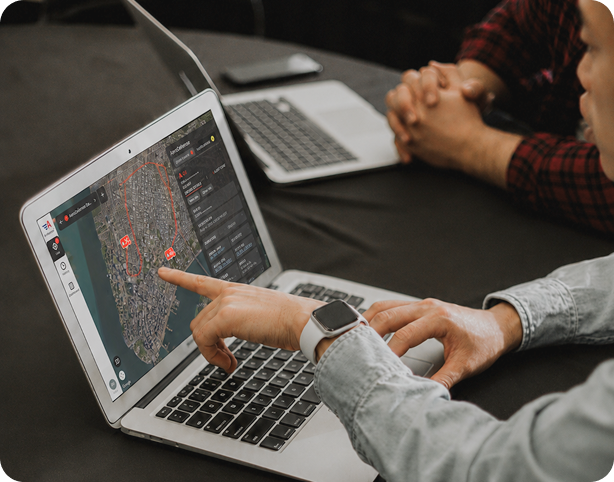
Monitor & Alert
Monitor activity across sites, create alert zones for layered response, and receive SMS or email notifications. Pre-approve known drones through Fleet and flag suspicious drones through Watchlist.
Dashboards & Historical Reports
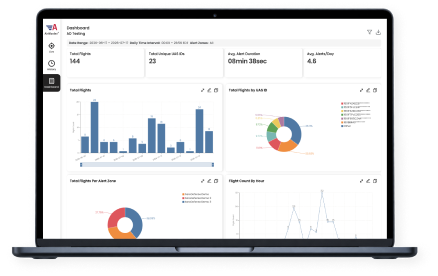
Interactive dashboards and historical reports help you explore flight activity, recognize patterns, and support enforcement and security planning.
Integrations & Map Controls
Essentials supports integrations with compatible third-party radar, cameras, GIS systems, and UTM networks. Map controls let your team show or hide activity from connected detectors.

Choose Your Detection Hardware

Choose AirWarden Remote ID Receivers, Spectrum Sensors, or a combination to supply drone activity data to Essentials. Both hardware options are developed and manufactured by AeroDefense in the United States.
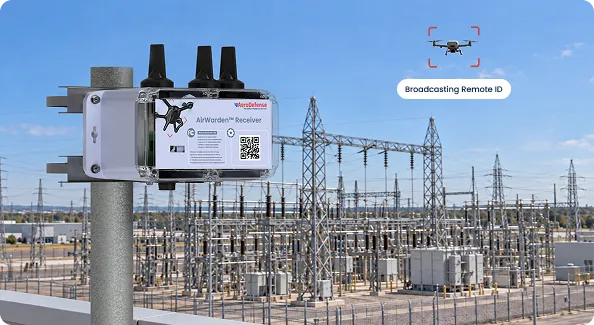
AirWarden Remote ID Receiver
Cost-effective Remote ID detection for facilities seeking greater airspace awareness, with plug-and-play installation. Receive drone and pilot locations from broadcast GPS data for drones broadcasting Remote ID.
Receivers support fixed, temporary, and mobile deployments, with self-installation and no environmental calibration required.
Receiver hardware is included with the AirWarden Remote ID subscription.
Explore the Solution
AirWarden Spectrum Sensors
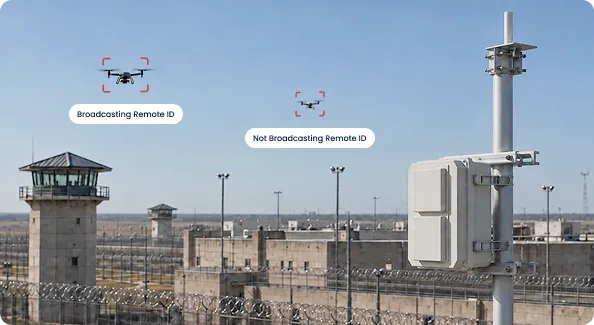
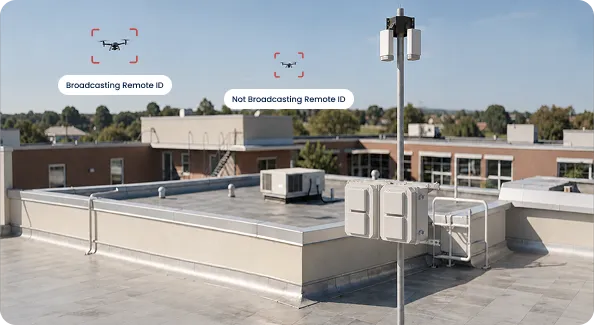
Combine Remote ID receiving with proprietary, patented Radio Frequency (RF) spectrum sensing to detect non-broadcasting drones, providing broader coverage for facilities with higher-risk security needs.
Spectrum sensing operates without intercepting signal content, avoiding the wiretap exposure associated with RF packet inspection. Spectrum sensors are purchased separately and require professional installation and environmental calibration.
Explore the Solution
AirWarden Direction Finder
Enhance location accuracy for non-broadcasting drones within an AirWarden Spectrum deployment. Designed for demanding security environments, the Direction Finder is trusted across high-risk facilities and critical infrastructure.
Pair a Direction Finder with a Spectrum sensor for a small location, or add Direction Finders to a larger sensor network to improve location accuracy. Direction Finders must be deployed with a Spectrum sensor.
Explore the Solution

A Closer Look at
AirWarden Hardware

Powerful airspace security starts with purpose-built hardware. We engineer and manufacture our detection technology in-house for quality, rapid deployment, and maximum accuracy.

AirWarden Drone Detection System

AirWarden drone detection systems address a wide range of drone-related safety and security challenges across various industries.
Real-Time Drone and Pilot Tracking
Stay aware of drones in your area with drone detection technology featuring real-time drone tracker capabilities to locate both the drone and its operator.
Automated Alerts to Enable Quick Response
Receive instant notifications about drone and operator activity to enable swift and effective responses — an essential capability for any drone defense system.
Scalable & Flexible Deployment
Deploy scalable, cost-effective solutions in minutes — portable or fixed to meet any operational need.
Made in USA
Eliminate concerns about availability and cybersecurity by choosing AeroDefense solutions developed and manufactured in the USA.
Historical Data Reporting
Access comprehensive records of past drone activity that identify trends and anomalies and enhance future security strategies.
Homeland Security SAFETY Act Designated
Deploy DHS SAFETY Act-designated drone detection technology that has demonstrated effectiveness and provides liability protections for qualifying claims arising from an Act of Terrorism.
Book a Meeting

Match Your Investment to Your Risk Level

Standard Risk
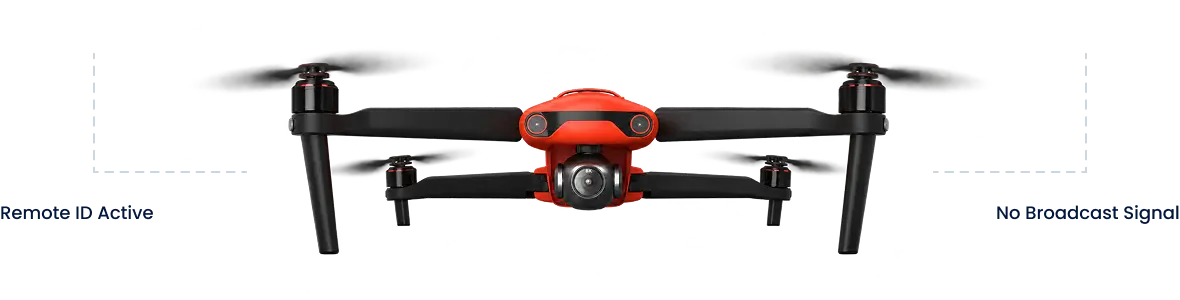
Most drone activity comes from hobbyists and licensed commercial operators flying FAA-compliant drones that broadcast Remote ID. AirWarden Remote ID detects these signals, providing an affordable way to monitor drone activity and understand your overall exposure.
Higher Risk
Drones that don’t broadcast Remote ID may indicate a more serious threat from highly skilled individuals. AirWarden Spectrum offers advanced capabilities to detect non-compliant or modified drones.
Keep in Mind
When assessing risk, remember that threat actors may use standard Remote ID drones for pre-operational planning. Non-broadcasting systems are rare and require significant expertise. All drone detection and counter-UAS efforts should be intelligence-driven. Early detection and pattern tracking reveal who is flying, enabling action before careless, clueless, or malicious activity becomes a problem.

AirWarden Integration Capabilities

AirWarden Essentials' open-platform architecture integrates seamlessly with UTM networks, radar systems, security cameras, and GIS systems via APIs allowing you to unify your airspace defense within your existing security ecosystem.

UTM

When integrated with UTM systems, AirWarden enables continuous monitoring and management of both cooperative and non-cooperative drones, providing comprehensive airspace visibility.

The system feeds real-time drone data into UTM networks, to ensure enhanced coordination between air traffic and drone operators.

Camera

Camera systems can be integrated with AirWarden to start recording automatically when a drone is detected, giving you a visual layer to complement the drone detector features.

This enables operators to quickly verify drone activity, improve situational awareness, and support post-incident investigations.
GIS

When integrated with GIS platforms, AirWarden adds real-time and historical drone activity to the maps and operational views your team already uses.

This helps organizations visualize drone locations, flight paths, pilot locations, and alert zones alongside other geographic data for more complete situational awareness.

Radar

AirWarden's compatibility with radar systems allows it to detect drones that may not emit electronic signatures, improving detection range and accuracy.

By merging radar data with AirWarden's proprietary RF-based detection capabilities, users achieve a robust solution for detecting even stealth or low-profile drones.

Explore Our Integration Partners

Request a Meeting
or a Demo

Whether you're ready for a meeting or exploring drone detection, our product experts can answer questions and help determine whether AirWarden Remote ID or Spectrum is right for your organization.
Thank you! Your submission has been received!
Oops! Something went wrong while submitting the form.
FAQ

Drone Detection Products FAQs ?

Find answers to common questions about AirWarden products, including the differences between Remote ID and Spectrum, deployment timelines, multi-site scalability, reporting capabilities, and temporary or mobile applications.
Didn't find your answer? Chat with the AeroDefense Navigator for immediate assistance.
What is the difference between AirWarden Remote ID and AirWarden Spectrum?
AirWarden Remote ID delivers cost-effective, scalable airspace awareness using Remote ID broadcasts — ideal for general monitoring and routine operations. It provides the ability to monitor multiple locations from one screen. AirWarden Spectrum provides Remote ID drone detection and advanced RF spectrum detection for high-risk sites, including the ability to detect non-compliant drones.
How quickly can AirWarden be deployed?
AirWarden Remote ID can be deployed in minutes—whether at a single building, across a campus, or at multiple sites—delivering immediate, real-time visibility into drone and pilot activity. AirWarden Spectrum, which leverages advanced RF spectrum capabilities, typically requires a more comprehensive setup and calibration process, with full deployment completed in approximately two weeks.
Can AirWarden scale across multiple sites or regions?
Absolutely. With AirWarden Remote ID you can link multiple receivers into a centralized system to monitor wide areas—from a single building to cities, regions, or nationwide—with virtual geofences and instant alerts.
What kind of reporting does AirWarden provide?
AirWarden generates historical data reports to identify trends, repeat drone activity, and patterns. Reports are available in PDF and CSV formats, making it easy to share across teams.
Is AirWarden suitable for temporary or mobile deployments?
Yes. AirWarden Remote ID can be deployed temporarily for events, emergency situations, or short-term airspace monitoring, as well as permanently for ongoing protection. AirWarden Spectrum is designed for permanent installations at high-security sites.